The debate surrounding 3D printed orthotics versus traditional orthotics has become increasingly relevant in modern podiatric practice. As manufacturing technologies advance and digital design tools become more accessible, foot care professionals face a critical decision: should they maintain legacy production methods or transition to additive manufacturing? This comparison examines the clinical, operational, and economic factors that define each approach.
Understanding the Fundamental Differences
Traditional Orthotics Manufacturing
Traditional orthotic production relies on established molding and fabrication techniques that have been refined over decades. The conventional process typically involves casting a patient's foot using plaster, foam, or digital scanning, then using that cast as a mold for heat-molding thermoplastic materials. Modifications and customizations are performed manually by certified orthotists, requiring specialized skills and experience.
The traditional method yields products with proven clinical efficacy, particularly for complex biomechanical corrections. Established materials such as EVA (ethylene-vinyl acetate), polypropylene, and various elastomeric compounds have extensive long-term performance data supporting their use across diverse patient populations and pathologies.
3D Printed Orthotics Technology
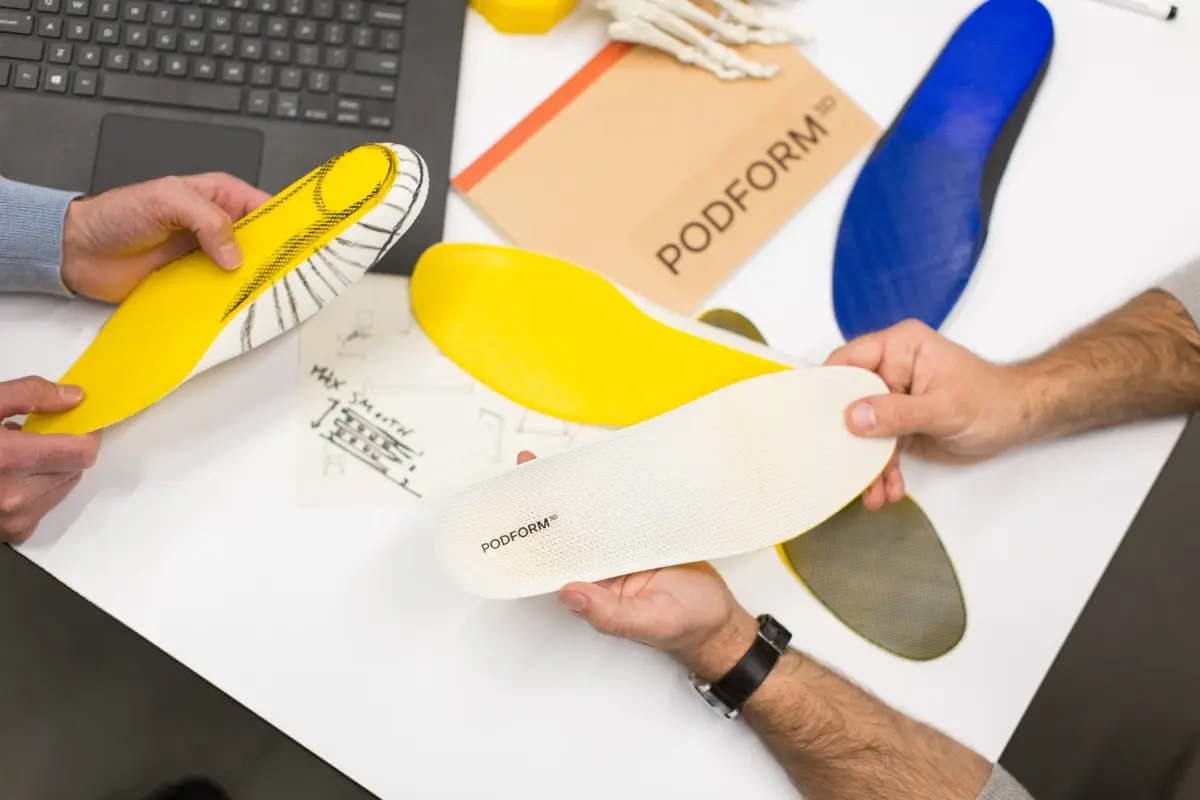
3D printed orthotics represent a digital-first approach to custom device manufacturing. The process begins with digital scanning—either through intraoral scanners or structured light 3D scanners that capture millimeter-level precision of the patient's foot architecture. CAD software then generates a 3D model that allows for parametric design modifications without physical prototyping. The finalized design is then produced using additive manufacturing technology, most commonly selective laser sintering (SLS), polyjet, or fused deposition modeling (FDM).
This methodology enables unprecedented control over material properties, density distribution, and biomechanical features at the design stage, rather than through post-production adjustments.
Dimensional Accuracy and Clinical Precision
One of the most critical differentiators between 3D printed and traditional orthotics is manufacturing precision. Research published in the Journal of Prosthetics and Orthotics demonstrates that 3D scanning and printing processes achieve dimensional tolerances of 0.1-0.5mm, compared to 1-3mm typical variation in hand-molded traditional devices.
For orthotic devices, this level of precision translates directly to clinical outcomes. Dorsal arch support, medial longitudinal arch alignment, and forefoot varus/valgus corrections all require sub-millimeter precision to achieve optimal biomechanical function. The consistency of 3D printing means that every unit produced matches the prescribed specification identically—a level of consistency impossible to achieve manually.
Traditional orthotics rely heavily on the skill and experience of the orthotist. While experienced practitioners produce excellent results, natural variation between craftspeople and between production batches introduces inconsistency that 3D printing eliminates entirely.
Production Timeline and Turnaround

Traditional orthotic manufacturing involves multiple sequential steps: casting appointment, cast curing, manual modifications, heat molding, final adjustments, and quality control. Each step requires physical handling and specialized facility space. This process typically requires 14-21 business days from initial casting to device delivery.
3D printed orthotics compress this timeline dramatically. Once a digital scan is captured, the design phase can be completed within 24-48 hours. Manufacturing itself—even accounting for post-processing and finishing—requires only 3-7 business days. This acceleration is particularly valuable for acute conditions where rapid intervention improves outcomes, and for clinical settings managing high patient volumes.
Cost Analysis: Materials, Equipment, and Labor
Initial Capital Investment
The primary barrier to 3D printed orthotics adoption is equipment cost. Entry-level 3D printers suitable for orthotic production range from $40,000 to $150,000, with advanced systems exceeding $200,000. Traditional orthotic labs require heat-molding equipment, vacuum-forming stations, and hand tools—typically totaling $15,000-$35,000.
However, cost-per-unit analysis reveals a different picture. Calculate your specific savings based on your production volume.
Per-Unit Production Cost
Material costs favor 3D printing for custom devices. A pair of traditional orthotics consumes approximately 8-12oz of raw thermoplastic material, but significant waste occurs during heat molding and manual fabrication. Net material utilization typically ranges from 50-65%.
3D printed orthotics use 2-4oz of material per pair, with material waste minimized to 5-10% through additive manufacturing efficiency. At current material costs ($15-$25 per kilogram for quality orthotic-grade polymers), this translates to $1.50-$3.50 in raw material per pair versus $8-$12 for traditional methods.
Labor represents the largest operational cost differential. Traditional orthotic fabrication requires 45-90 minutes of skilled technician time per pair. At prevailing wage rates for certified orthotists ($22-$35 per hour), labor cost per unit ranges from $16.50-$52.50. 3D printing requires approximately 10-15 minutes of technician time (primarily scanning, software interaction, and finishing), reducing labor cost to $3.75-$8.75 per pair.
For facilities producing 50+ pairs weekly, 3D printing achieves cost parity with traditional methods within 18-24 months of equipment purchase, then delivers ongoing per-unit savings of 40-60%.
Material Properties and Long-Term Performance
Material Selection
Traditional orthotics utilize decades-old material formulations with extensive clinical validation. EVA compounds, for instance, have predictable durability profiles, well-understood load-bearing characteristics, and established shelf-life specifications.
3D printed orthotics employ newer polymer systems including polyamide, resin-based composites, and elastomers specifically engineered for additive manufacturing. While clinical track records are shorter, accelerated durability testing demonstrates comparable performance to traditional materials across relevant biomechanical parameters. Materials like Nylon 12 used in SLS printing show creep resistance and fatigue properties equivalent to traditional EVA compounds.
A critical advantage of 3D printing is material heterogeneity—the ability to utilize different materials or material densities in different regions of a single device. This enables arch support density to differ from heel cushioning material, optimizing response characteristics for specific biomechanical functions.
Durability and Device Lifespan
Both manufacturing approaches produce devices with expected lifespans of 12-24 months under typical usage. Failure mechanisms differ slightly: traditional orthotics commonly fail through material degradation and separation at bonded interfaces, while 3D printed devices show excellent interface integrity but may develop wear at high-contact areas.
Clinical evidence suggests neither approach has a meaningful durability advantage. Device replacement typically reflects biological need (change in foot structure, progression of pathology) rather than material failure in either modality.
Customization Flexibility and Design Control
This category represents perhaps the most significant advantage of 3D printed orthotics. CAD-based design enables modifications impossible or impractical in traditional manufacturing:
- Parametric geometry: Arch heights, forefoot angles, and support distributions can be adjusted numerically rather than through re-molding cycles
- Material grading: Density can vary continuously from 30% to 100% across different regions, optimizing load distribution
- Rapid iteration: Design modifications can be tested virtually before manufacturing, reducing trial-and-error cycles
- Patient-specific features: Accommodations for lesions, calluses, or structural anomalies can be designed directly into the device rather than added post-production
- Precise alignment: Forefoot varus/valgus, rearfoot inversion/eversion, and metatarsal head relief can all be programmed to exact specifications
For complex cases requiring significant customization, 3D printing provides superior clinical outcomes and reduced adjustment appointments.
Comparative Performance Table
| Factor | 3D Printed | Traditional |
|---|---|---|
| Production Time | 5-10 business days | 14-21 business days |
| Dimensional Tolerance | 0.1-0.5mm | 1-3mm |
| Material Cost per Pair | $1.50-$3.50 | $8-$12 |
| Labor Cost per Pair | $3.75-$8.75 | $16.50-$52.50 |
| Total Production Cost | $5.25-$12.25 | $24.50-$64.50 |
| Equipment Investment | $40,000-$200,000 | $15,000-$35,000 |
| Design Customization | Unlimited parametric control | Limited to post-production modification |
| Material Consistency | Batch-to-batch identical | Technician-dependent variation |
| Device Lifespan | 12-24 months | 12-24 months |
| Skill Requirements | Software/design skills | Manual fabrication expertise |
Clinical Outcomes and Patient Satisfaction
Long-term comparative data on clinical outcomes remains limited, as widespread 3D printed orthotic adoption is relatively recent. However, published studies comparing digitally-designed 3D printed devices to traditionally manufactured orthotics show equivalent or superior outcomes across measured parameters including pain reduction, functional improvement, and patient satisfaction.
The superior dimensional precision of 3D printed orthotics may confer advantages in specific clinical scenarios: severe pes planus requiring precise arch geometry, complex forefoot deformities, and patients with high sensitivity to fit parameters. For routine cases, both approaches produce clinically equivalent results.
Patient satisfaction metrics favor 3D printing primarily due to reduced turnaround time and fewer adjustment appointments. The faster time-to-delivery supports better clinical outcomes by reducing the interval between diagnosis and intervention.
Making the Transition: Implementation Considerations
For Individual Practitioners
Solo practitioners should evaluate patient volume and case complexity carefully. If producing fewer than 30 pairs monthly, traditional methods typically remain more cost-effective. For practices exceeding 40 pairs monthly, the calculation favors 3D printing within 24 months.
Outsourcing to specialized 3D printing facilities offers a middle path: access to digital technology and accelerated turnaround without equipment investment. Explore our 3D printer technology or learn about our complete orthotic solutions.
For Established Orthotic Facilities
Facilities with existing traditional manufacturing capacity can implement 3D printing incrementally. Beginning with complex cases or high-volume clients allows staff to develop competency with digital workflows while maintaining production continuity. Hybrid approaches—combining traditional and digital manufacturing—optimize cost and outcomes across diverse patient needs.
Staff Training and Transition
The shift from manual fabrication to digital design requires different skill sets. Current orthotists possess valuable clinical knowledge that translates directly to digital workflows; the transition primarily involves learning CAD software and understanding digital design principles rather than abandoning established clinical expertise.
Future Trajectory of Orthotic Manufacturing
Market trends strongly suggest continued growth in 3D printed orthotic adoption. Material science advances are expanding available polymers, improving durability and enabling novel material combinations. Software tools continue to become more intuitive, lowering the learning curve for practitioners. Equipment costs are gradually declining as manufacturing scales up.
The convergence of improved scanning technology, AI-assisted design, and advanced materials manufacturing suggests that 3D printing will eventually dominate custom orthotic production, particularly for complex cases and high-volume applications.
Conclusion
Both 3D printed and traditional orthotics remain clinically valid approaches to custom device manufacturing. 3D printing offers significant advantages in production speed, dimensional consistency, labor efficiency, and design flexibility. Traditional methods continue to excel in material familiarity, established long-term outcome data, and lower initial capital requirements.
The optimal choice depends on practice-specific factors: patient volume, case complexity, available capital, and production capacity requirements. Progressive practices increasingly incorporate 3D printing technology to enhance patient outcomes and operational efficiency while maintaining the clinical expertise that has always been central to quality orthotic care.
For foot care professionals considering the transition, the data strongly supports implementation of 3D printed orthotic technology—particularly for practices producing more than 30 pairs monthly. The combination of improved clinical precision, accelerated turnaround, and favorable long-term economics positions 3D printing as the advancing standard in modern podiatric practice.
Ready to Transform Your Orthotic Practice?
Explore how Podform3D's 3D printing technology can streamline your production, improve patient outcomes, and reduce per-unit costs by 40-60%.