In-clinic 3D printing orthotics represents a fundamental shift in how podiatrists, chiropodists, and pedorthists deliver custom care. Gone are the days of sending patient scans to distant labs and waiting weeks for delivery. With modern orthotic printing technology, you can fabricate custom orthotics on-site, reduce turnaround time from weeks to hours, and improve patient outcomes while increasing profitability.
This guide walks you through everything you need to know to implement in-clinic orthotic printing, from initial setup through your first week of production. Whether you're concerned about space constraints, training requirements, or return on investment, we address the questions every clinic asks.
Why In-Clinic 3D Printing Orthotics Changes Your Practice
The traditional orthotic fabrication workflow involves multiple steps, external vendors, and extended wait times. Patients schedule appointments, receive casts or scans, then wait 2-4 weeks for laboratory orthotics. During that time, they experience discomfort, may lose motivation, and represent a liability for your clinic.
By bringing orthotic printing in-house, you eliminate these pain points. Patients walk out with custom orthotics during their first visit, creating immediate satisfaction and clinical effectiveness. More importantly, you control quality, reduce dependency on external labs, and capture the full margin on orthotic production.
The financial impact is substantial: clinics operating an in-clinic orthotic printing setup report recovering equipment costs within 6-12 months while simultaneously improving patient retention and referral rates.
What You Need: The Complete Setup
Starting with in-clinic orthotic printing requires three core components. The good news: modern solutions integrate seamlessly, and no 3D printing expertise is necessary.

1. Scanner for Digital Capture
The foundation of your scan to print orthotics workflow is a reliable 3D scanner. Options include:
- Structured light scanners - High accuracy, consistent results, ideal for clinics processing multiple patients daily
- Photogrammetry systems - Smartphone-based or professional solutions, good for clinics with lower scan volume
- LIDAR scanners - Rapid acquisition, excellent for capturing patient feet in natural position
Choose a scanner that integrates with your selected software platform. Integration eliminates manual file conversion steps and reduces errors in the digital orthotic workflow.
2. Design Software
Specialized orthotic design software allows you to convert raw scans into optimized models for 3D printing. Modern platforms include:
- Intuitive interfaces requiring no CAD experience
- Pre-built orthotic templates for common conditions
- Automatic density optimization for weight and durability
- Direct integration with printer systems
The best software platforms are specifically designed for orthotics, not generic 3D modeling. This ensures your designs manufacture successfully without troubleshooting.
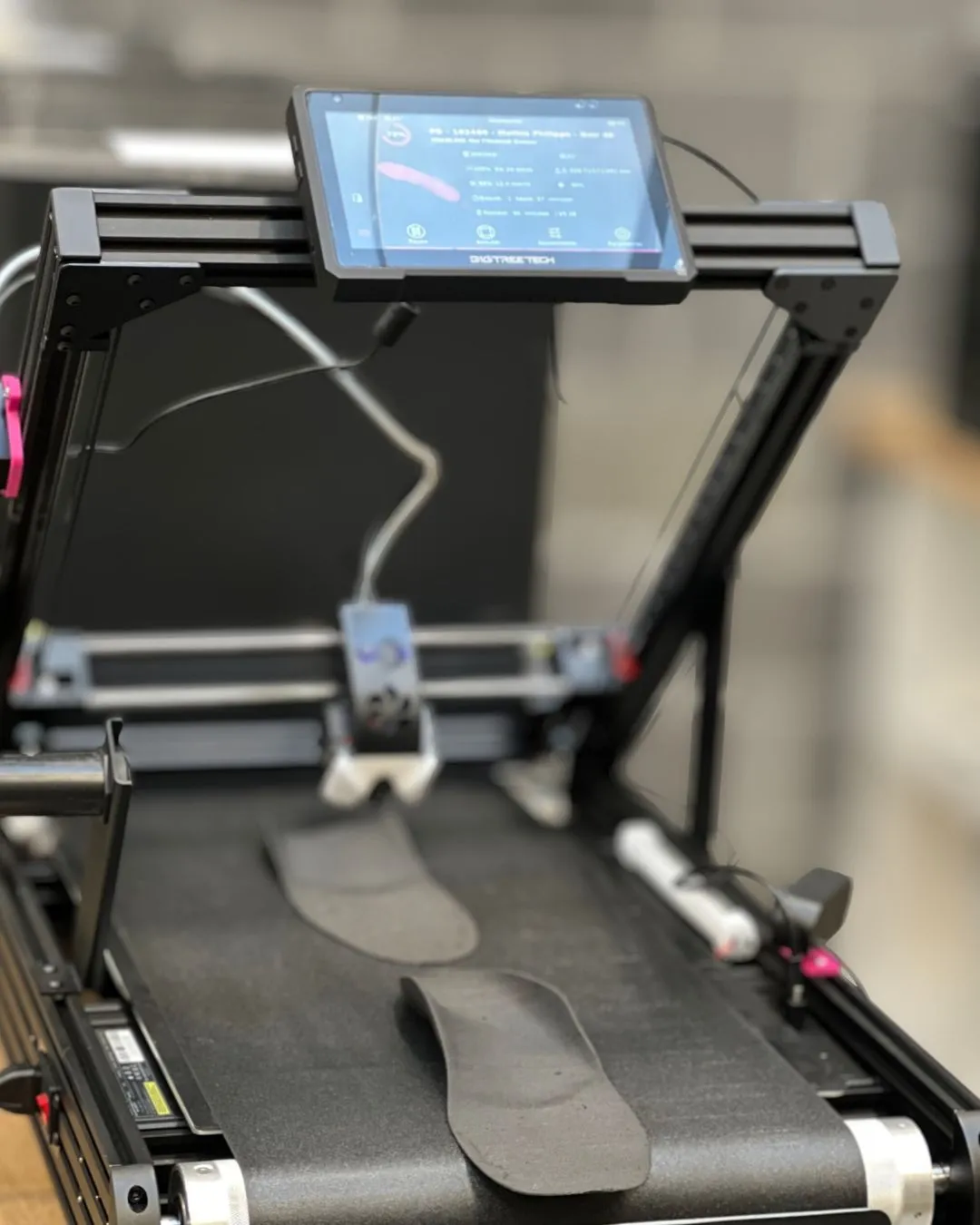
3. Dedicated Orthotic Printer
Your printer is the production engine. Look for an orthotic printer for clinics with these characteristics:
- Autonomous belt technology allowing 72+ hours of unattended production
- Capacity for 5+ pairs per day per printer
- High precision adequate for clinical tolerance requirements
- Support for medical-grade materials approved for orthotic use
- Integrated post-processing (minimal finishing required)
- Easy material management and supply sourcing
The printer is your profit center. An autonomous belt printer runs continuously, producing high volumes without requiring full-time operator attention. This efficiency directly translates to lower per-unit costs and faster patient delivery.
The 4-Step Digital Orthotic Workflow
Once your system is installed, the daily process is remarkably simple. Here's exactly what happens from patient arrival to orthotic delivery:
1Scan the Patient's Foot
The patient stands or sits as you capture a 3D scan of their foot in natural position. Modern scanners complete this in 30-60 seconds. No messy casting materials, no curing time, no shipping delays.
The scanner automatically generates a digital foot model that integrates directly with your design software. The entire scan-to-digital-file process takes just minutes.
2Design the Custom Orthotic
Your clinician loads the foot model into design software and selects the appropriate orthotic template based on diagnosis and treatment goals. Modern software includes built-in templates for:
- Plantar fasciitis support
- Arch correction and flatfoot management
- Diabetic foot care orthotics
- Sports performance optimization
- Pediatric growth-responsive designs
You customize density, arch height, material properties, and posting within minutes. No CAD experience required. The software automatically validates the design before sending to print.
3Print the Custom Orthotic
Your approved design sends directly to the printer. An autonomous belt printer begins producing your orthotic immediately, running continuously for up to 72+ hours with multiple orthotics queued. Your staff doesn't need to babysit the printer.
During this time, the printer can complete 5+ pairs per day, processing overnight and weekend production automatically. The printer handles positioning, support material management, and quality consistency.
4Finish and Deliver to Patient
Once printing completes, minimal post-processing occurs: removal of support material, trimming of edges, and application of any finishing touches. Unlike traditional manufacturing, the orthotic is ready for immediate patient use.
For most patients, this happens the same day or next morning. Some patients receive orthotics during their first appointment, dramatically improving satisfaction and clinical outcomes.
Timeline to Full Operational Capacity
A common question: how quickly can you move from equipment installation to full production? With proper system selection, the answer is surprisingly fast.
Equipment installation and calibration - Your equipment arrives and integrates with your clinic network. Initial calibration ensures scanner accuracy and printer precision.
Staff training - Your team learns scanning technique, software navigation, and design workflows. Most clinicians achieve proficiency in 2-3 hours of hands-on practice.
First test prints - Your team produces sample orthotics using training scans. You verify print quality, test fitting, and review post-processing procedures.
Patient production begins - You scan and print real patient orthotics. Troubleshooting and optimization occur with minimal disruption to daily operations.
Full capacity operation - Your clinic is producing 3-5 custom orthotics per day with streamlined workflows. The printer runs continuously, generating finished orthotics during overnight and weekend hours.
With a properly designed system like those offered by Podform3D, you can achieve full operational capacity within 48 hours of installation. This rapid implementation means minimal disruption to your existing operations while immediately improving your orthotic fabrication process.
Addressing Common Implementation Concerns
Space Requirements
A modern 3D printing system doesn't require a dedicated laboratory. Your scanner, software workstation, and printer occupy roughly the same footprint as a typical office desk. Many clinics integrate the system into existing treatment areas or allocate unused storage space for the printer itself.
The autonomous belt printer operates continuously without requiring workspace around it, so placement in a back room or office corner works perfectly.
Noise and Safety
Modern orthotic printers operate at normal office volumes - quieter than many diagnostic devices your clinic already uses. Ventilation requirements are minimal; standard office HVAC handles printer emissions adequately.
Safety considerations are minimal. Your staff doesn't directly handle printing materials; they load material and unload finished orthotics. Standard workplace safety practices apply.
Training and Experience Required
This is the question every clinic asks: "Do we need 3D printing experts?" The answer is a definitive no. Modern systems are designed for clinical use, not technical operation. Your podiatrists and clinical staff learn the workflows through 2-3 hours of hands-on training.
Software interfaces are intuitive, built specifically for orthotic design rather than generic 3D modeling. Template-based design means most orthotics can be fabricated without custom design work.
Print Quality and Durability
Modern orthotic materials meet or exceed durability standards for traditional laboratory orthotics. Prints are durable, lightweight, and responsive to clinical modification (grinding, padding, adjustments).
Medical-grade materials ensure biocompatibility and performance across patient populations, from pediatric through geriatric care. Quality consistency is actually superior to traditional lab work because digital manufacturing eliminates human variability.
Return on Investment and Financial Impact
The financial case for in-clinic orthotic printing is compelling. Let's break down the numbers:
Beyond direct margin, in-clinic printing improves patient outcomes (faster delivery, same-day fitting), increases referrals due to superior service, and reduces reliance on external lab relationships. These indirect benefits often exceed the direct margin improvement.
Most clinics printing 3-5 orthotics per week recover equipment investment within 6-12 months while maintaining pricing aligned with or better than traditional lab models.
Getting Started: Your Next Steps
Ready to implement in-clinic orthotic printing? Here's how to move forward:
- Review the complete workflow - Understand how the system integrates with your clinic operations
- Explore full solution details - Learn about integrated scanner, software, and printer systems designed for clinics
- See the dedicated orthotic printer - Review specifications and autonomous production capabilities
- Order a free sample orthotic - Hold a Podform3D-printed orthotic and feel the quality firsthand
- Review financial impact and savings models - See specific ROI projections for your clinic type
- Schedule a live demonstration - See the complete workflow in action with trained specialists
Implementation is faster than you think. Within 48 hours of installation, your clinic can be producing custom orthotics on-demand, transforming your patient experience and profitability.